Software architecture is one of those topics where everyone seems to have a strong opinion. Some engineers believe every application should be a collection of microservices, while others argue that a well-designed monolith can scale just fine. After working on multiple production systems, my perspective has become much simpler: Architecture should solve your current problems, not the problems you might have five years from now. Both monoliths and microservices are excellent architectural styles. Neither is universally better. The right choice depends on your team, your product, and the complexity you're trying to manage. Here's how I personally see them.
1. The Monolith: Built for Speed and Simplicity
A monolithic application is exactly what it sounds like: one application, one deployment, one codebase, and one runtime. Every feature—authentication, payments, emails, messaging, reporting, and APIs—lives inside the same application. Many developers underestimate monoliths because they associate them with outdated systems, but a modular monolith can power very large businesses.
- Development Is Fast: Calling another feature is usually just a function call. You don't have to think about network latency or distributed API contracts.
- Easier Debugging: You have one application log, one debugger, and one database transaction. Finding a problem is straightforward.
- Simpler Deployment: With one deployment pipeline and one server (or cluster), CI/CD becomes significantly easier and infrastructure costs stay low.
- Better for Small Teams: Solo developers or small startups can focus on building features rather than managing API gateways, message brokers, and container orchestration.
2. The Downsides of a Monolith
The biggest weakness of a monolith is that everything runs together. If one critical module begins consuming excessive CPU, memory, or threads, it can affect the entire application.
- Shared Failure Domains: If email sending is handled synchronously and times out, requests may pile up, increasing resource usage and slowing down the whole system.
- Inefficient Scaling: If only your messaging feature receives heavy traffic, you must scale the entire application, resulting in higher infrastructure costs and wasted resources.
3. Microservices: Built for Scale and Independence
Microservices divide a system into multiple independent services. Each service owns a specific business domain (e.g., Authentication, Payments, Inventory) and communicates with other services through APIs, events, or message queues.
- Excellent Scalability: If only the notification service experiences heavy traffic, you scale just that service, leading to much better infrastructure efficiency.
- Higher Reliability: A properly designed architecture isolates failures. If notifications go down, orders can still be processed and queued for later delivery.
- Technology Freedom: Different problems deserve different tools. A banking module might use Node.js, a high-performance blockchain component Rust, and an ML service Python.
- Team Independence: Multiple teams can work simultaneously on different domains, allowing independent deployments without waiting for the entire application to be tested together.
4. The Challenges of Microservices
Microservices introduce a different kind of complexity. Instead of writing business logic only once, you're constantly thinking about communication between services. The application becomes a distributed system—and distributed systems are inherently harder to build and debug.
- Network Complexity: You must constantly answer questions about authentication between services, synchronous vs. asynchronous calls, and retry mechanisms for failed requests.
- Data Consistency & Tracing: Maintaining data consistency across multiple databases and tracing requests that pass through six different services requires heavy tooling.
- Infrastructure Overhead: You rapidly need API Gateways, Service Discovery, Centralized Logging, Distributed Tracing, Message Brokers, and CI/CD pipelines for every single service.
5. My Personal Verdict
This is where my opinion differs from the trend of "microservices everywhere." Because my time is limited, I would rather spend my energy building business features than maintaining infrastructure.
- Solo developer or a small team? Start with a well-structured modular monolith. Keep deployment and debugging simple.
- Growing engineering organization? Consider microservices only when the complexity of your product truly demands them and you have multiple independent teams.
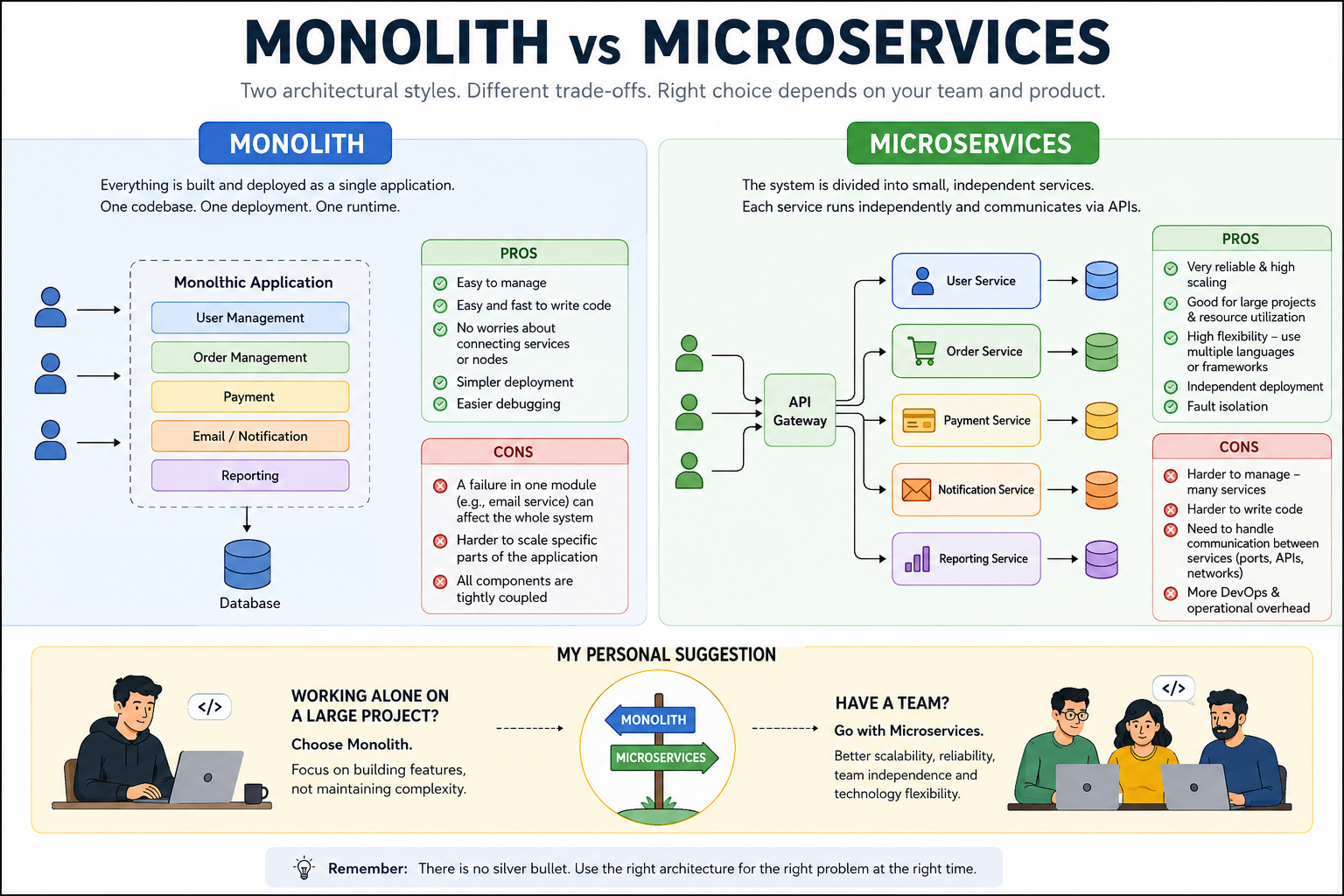
Summary
The industry sometimes treats microservices as the "modern" choice and monoliths as something outdated. I don't see it that way. A poorly designed microservice architecture is far more difficult to maintain than a well-designed monolith. Likewise, an oversized monolith with tightly coupled code can become just as painful as a distributed system. The goal isn't to follow trends. The goal is to choose the architecture that helps your team deliver software reliably. Sometimes, the simplest solution is the one that survives the longest.